
Best Billing System for Retail Shops with GST
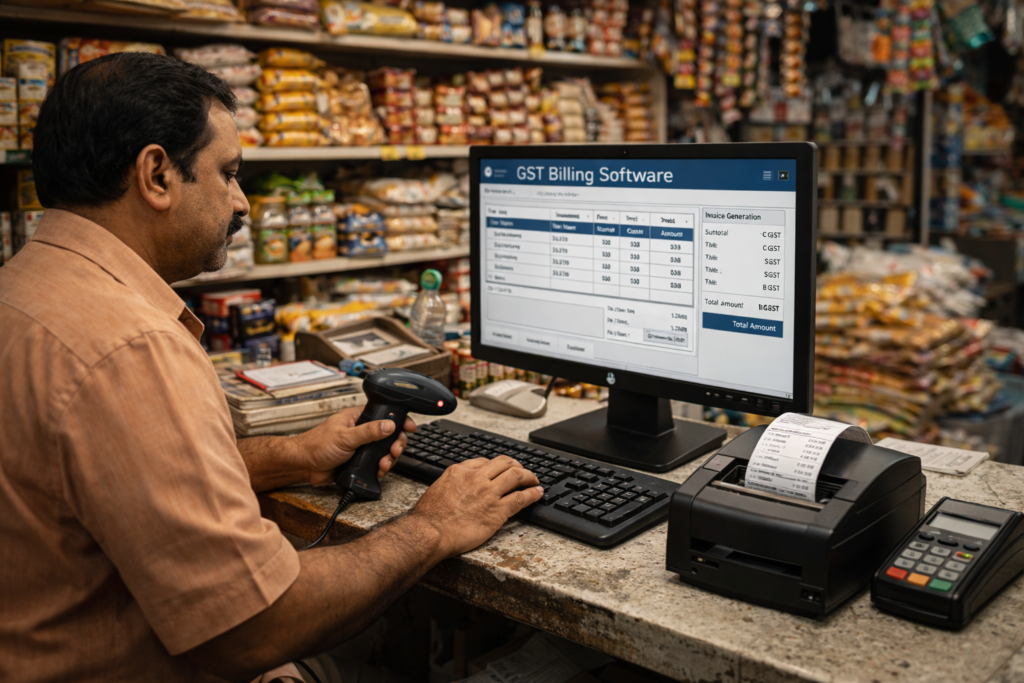
Running a retail shop in India means dealing with GST invoicing, HSN codes, GSTR-1 filing, and stock management — all at once. A smart billing system for retail shops with GST doesn’t just print receipts — it automates compliance, eliminates manual errors, and helps you grow. This guide breaks down everything you need to know before choosing the right software.
What Is a Billing System for Retail Shops with GST?
A billing system for retail shops with GST is a software solution that combines point-of-sale (POS) functionality with GST-specific invoicing, tax calculation, and return filing preparation. Unlike generic invoicing tools, retail GST billing software understands India’s tax slabs (0%, 5%, 12%, 18%, 28%), generates HSN/SAC code-compliant bills, and exports data for GSTR-1, GSTR-2A, and GSTR-3B.
Must-Have Features in a Retail GST Billing System
Not all billing software is created equal. Here are the non-negotiable features your retail shop needs:
🧾
GST-Compliant Invoices
Auto-calculates CGST, SGST, and IGST. Supports B2B and B2C invoice formats as per GST rules.
📦
Inventory Management
Track stock in real-time, set reorder alerts, and sync inventory with billing automatically.
🏷️
HSN / SAC Code Lookup
Built-in HSN code database ensures every product is tagged correctly for GST compliance.
📊
GSTR-1 / 3B Export
One-click export of GST return data in the format accepted by the GST portal or your CA.
💳
Multiple Payment Modes
Supports UPI, cash, card, credit — all recorded and reconciled within the billing system.
📱
Mobile & Cloud Access
Access billing, reports, and stock from anywhere — essential for multi-outlet retailers.
🔐
Customer Ledger & Credit
Maintain customer accounts, credit limits, and outstanding payments with ease.
📈
Sales & Tax Reports
Daily, monthly, and yearly sales reports with tax summaries — crucial for smart decision-making.
GST Compliance Checklist for Retail Billing Software
- Auto-populated GSTIN on invoices
- HSN code mapping for all products
- CGST + SGST split for intra-state
- IGST for inter-state transactions
- E-invoice generation (IRN + QR Code)
- Reverse charge mechanism suppor
- Credit note & debit note management
- Composition scheme billing support
- GSTR-1 JSON export for GST portal
- Input Tax Credit (ITC) tracking
- B2B and B2C invoice differentiation
- Audit trail with tamper-proof logs
Manual Billing vs GST Billing Software
Still maintaining paper registers or using basic Excel sheets? Here’s how the right billing system transforms your retail operations:
Aspect
Invoice Generation Speed
GST Calculation Errors
GSTR-1 Filing Prep
Inventory Sync
Compliance Risk
Business Reports
Scalability
Cost (Long Term)
Manual / Excel Billing
5–10 minutes per bill
Frequent — human error
Manual data entry (hours)
Manual & error-prone
High — penalty risk
Time-consuming
Difficult to scale
Higher (penalties + time)
GST Billing Software
Under 60 seconds
Zero — auto-calculated
One-click export
Real-time automatic
Minimal
Instant dashboards
Cloud-based, multi-outlet
Lower with ROI
Which Retail Shops Need a GST Billing System?
A billing system for retail shops with GST is essential for virtually every type of registered retailer in India. Whether you run a single kirana store or a multi-branch supermarket, the right software scales with you.
✔ Grocery & Kirana Stores
✔ Clothing & Apparel Shops
 Medical & Pharmacy Shops
Footwear & Accessories Shops
Auto Parts & Accessories
Sweet Shops & Food Outlets
✔ Supermarkets & Hypermarkets
Electronics & Mobile Stores.
Hardware & Building Material Stores
FMCG Distributors & Wholesalers
Stationery & Book Stores
Furniture & Home Décor Stores
How to Choose the Best Billing System for Your Retail Shop
1. Identify Your Business Size & Volume
A small kirana store processing 50 bills/day has different needs than a clothing chain with 5 outlets. Choose software that matches your daily transaction volume and scales affordably as you grow.
2. Check GST Certification
Always verify that the software is a GST Suvidha Provider (GSP) approved or integrated solution. Look for compliance with GSTN’s e-invoicing API if your turnover exceeds ₹5 crores.
3. Evaluate Ease of Use
Your billing staff shouldn’t need a tech degree. Look for software with a clean touchscreen-friendly POS interface, keyboard shortcuts, and quick search for products.
4. Look for Offline + Online Capability
Internet disruptions are real. The best retail billing software works offline and syncs data to the cloud automatically when connectivity is restored — ensuring uninterrupted business operations.
5. After-Sales Support & Training
Prioritise vendors offering dedicated onboarding, GST update support (whenever the government changes tax slabs), and responsive customer service via phone or WhatsApp.
Make the Smart Switch to GST Billing Software Today
A modern billing system for retail shops with GST is no longer a luxury — it’s a business necessity. It protects you from compliance penalties, speeds up checkout, gives you real-time business insights, and frees up hours every month that were previously lost to manual data entry and reconciliation.
Whether you run a neighborhood kirana store or a multi-outlet retail chain, the right billing system pays for itself within the first quarter — through saved penalties, recovered ITC, and faster operations.
Frequently Asked Questions
Q1. What is a billing system for retail shops with GST?
A GST billing system for retail shops is software that combines point-of-sale (POS) invoicing with India's GST tax engine. It auto-calculates CGST, SGST, and IGST, applies correct HSN/SAC codes, and generates GST-compliant invoices — all in under a minute. Unlike generic billing tools, it's built around India's multi-slab tax structure (0%, 5%, 12%, 18%, 28%).
Q2. Is GST billing software mandatory for retail shops in India?
No specific software is mandated by law. However, every GST-registered business must issue GST-compliant invoices that include GSTIN, HSN codes, tax breakup, and invoice number. Doing this manually is error-prone and risky — billing software makes compliance automatic and audit-proof.
Q3. What is e-invoicing and which retailers need it?
E-invoicing is a government mandate requiring B2B invoices to be registered on the Invoice Registration Portal (IRP), which issues an IRN (Invoice Reference Number) and embeds a QR code. As of 2024, businesses with annual turnover above ₹5 crores must comply. Your billing software must support IRP integration for this.
Q4. Can billing software help me track Input Tax Credit (ITC)?